
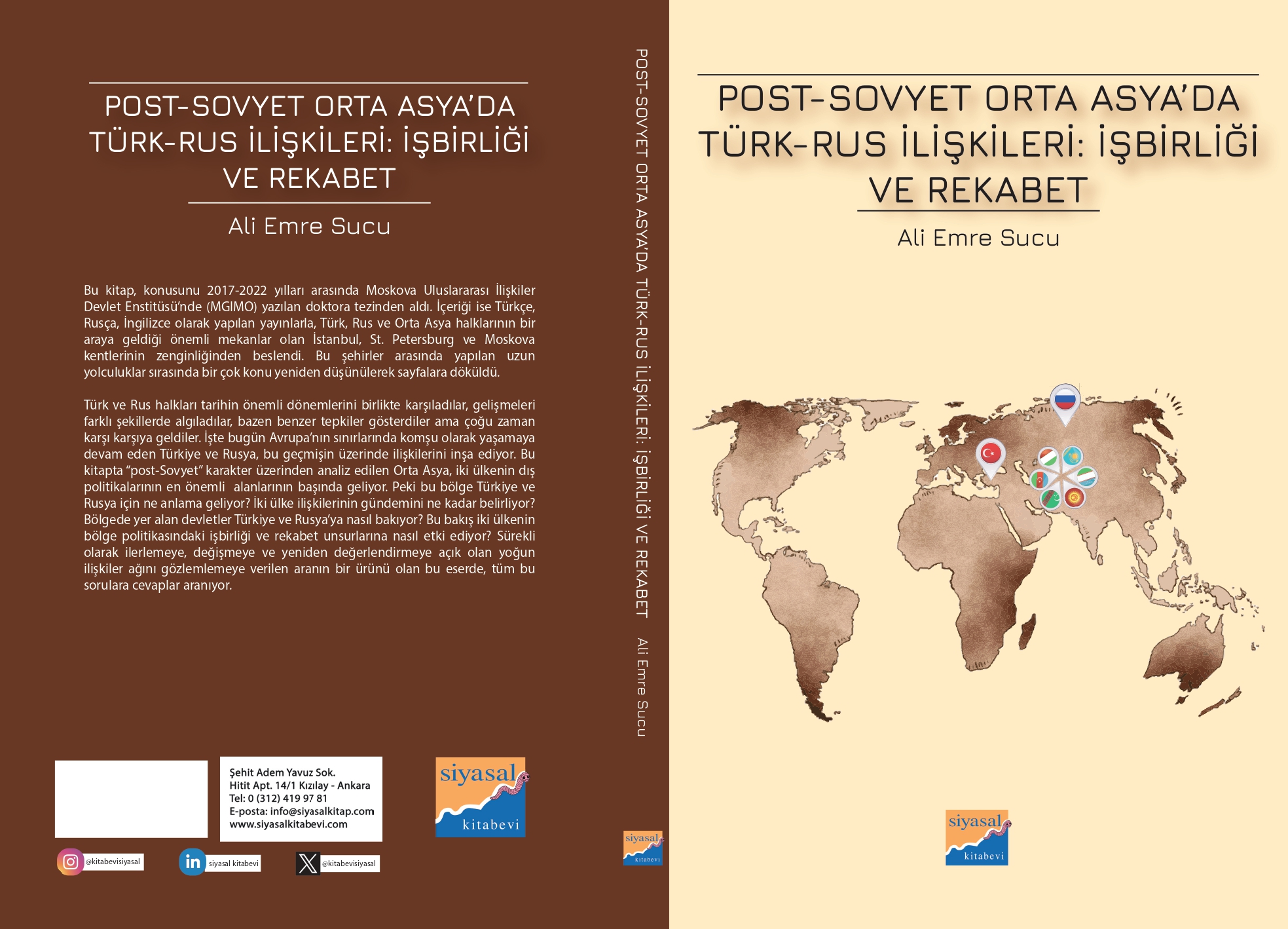
Dr. Ali Emre Sucu, Assistant Professor at Ankara University, Faculty of Political Science, Department of Political Science and Public Administration, Comparative Politics Division, recently published his book Post-Soviet Central Asia in Turkish-Russian Relations: Cooperation and Competition through Siyasal Kitabevi.
The book draws from his doctoral dissertation, written between 2017-2022 at the Moscow State Institute of International Relations (MGIMO). It builds on a rich diversity of Turkish, Russian, and English publications and cultural exchanges in significant cities like Istanbul, St. Petersburg, and Moscow. This work delves into the complex dynamics of Central Asia as a focal point in the foreign policies of Turkey and Russia. What does the region mean for both nations? How does it shape bilateral relations? How do regional states perceive Turkey and Russia, and how do these perceptions impact cooperation and competition in their regional policies? The book addresses these questions by offering a pause to critically observe and evaluate the intricate web of relations in this region.
The content is divided into six chapters:
- Global Politics in the 21st Century: This chapter introduces global politics, evaluating Turkey’s and Russia’s positions, resources, and foreign policy practices.
- Post-Soviet Central Asia: Examines the region’s “post-Soviet” legacy and current challenges, comparing political structures and analyzing economic and military data.
- Historical Context of Turkish-Russian Relations: Explores the evolution of relations from the imperial and Soviet eras to the 1990s and 2000s, highlighting the complexity of their character and structure.
- Turkey’s Regional Policies: Analyzes Turkey’s policies in the region across various periods and domains, such as political, economic, and soft power initiatives.
- Russia’s Regional Policies: Explores Russia’s regional strategies and how its policies intersect with Turkey’s interests.
- Cooperation and Competition in Regional Policies: Focuses on the ideological, political, economic, military, and soft power dimensions of Turkish-Russian interactions in the region. The chapter concludes with projections about the role of post-Soviet Central Asia in shaping the future of Turkish-Russian relations.
Leave a Reply