
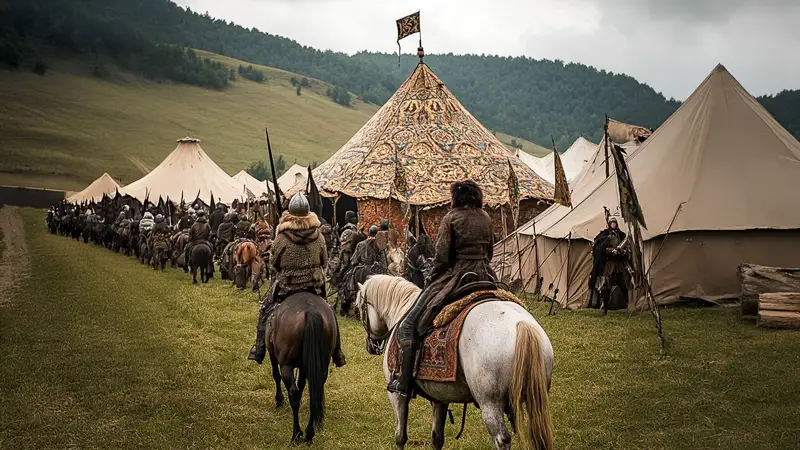
The Kazakh Khanate, founded in the 15th century, initially did not adhere to the traditional concept of a permanent capital. Unlike many sedentary Eastern empires, the Khanate’s political and administrative structure was based on a nomadic system. In such a system, the capital was not a fixed city; rather, it was wherever the khan was located. The term “Ak-Orda” referred to the royal tent or temporary residence, which functioned as the center of power at any given time.
This early nomadic governance of the Kazakh Khanate was drastically different from the centralized monarchies that were prevalent in Eastern Asia and the Middle East. The khan’s authority was somewhat fluid and dependent on the support of local tribal leaders, and the khan’s power was often decentralized. There was no fixed capital city in the typical sense; instead, the political and administrative heart of the Khanate moved according to the seasonal migration of the khan’s court.
However, as the Khanate expanded, the need for a more established administrative center grew. Over time, key cities and regions were used as temporary capitals, and the capital of the Kazakh Khanate shifted based on political, military, and cultural considerations.
Ak-Orda: The First Nomadic Capital
The concept of “Ak-Orda,” meaning “White Horde,” was central to the early structure of the Kazakh Khanate. This term referred not only to the physical tent or residence of the khan but also to the broader political sphere in which the khan’s power was exercised. In the early years, the khan’s residence would serve as a symbolic and functional capital. Key cities like Sighnak, Sozak, and Otrar were part of the broader Kazakh Khanate’s influence, but none were officially regarded as capitals in the way a modern state would define its capital.
In this system, the power of the Khan was tied to his mobility and his ability to maintain control over various tribal confederations. The Ak-Orda represented this fluid governance structure, and the political center would move with the khan’s seasonal migrations, reflecting the semi-nomadic nature of Kazakh society.
The Capture of Saraychik: A Brief Reign as Capital
In the 16th century, the Kazakh Khanate began to expand westward. Under the leadership of Khan Kasym, the Khanate’s military campaigns targeted the Nogai Horde, and in the process, Kasym conquered the strategic city of Saraychik, which had previously been the capital of the Nogai Horde. Saraychik was an important political and commercial hub, strategically positioned along trade routes.
For a brief period, Saraychik served as the capital of the Kazakh Khanate, symbolizing the Khanate’s reach and its growing territorial ambitions. However, after Kasym’s death, the political dynamics in the region shifted. Saraychik was lost, and the Kazakh Khanate experienced territorial contraction, with parts of the territory falling under the control of competing powers. Thus, the Khanate’s political center continued to shift as the khanate faced internal divisions and external pressures.
The Dual Capital Era: Turkestan and Tashkent
By the late 16th century, a significant change occurred when Khan Tauke began expanding southward. His campaigns led to the conquest of several key cities, including Turkestan, Tashkent, and the cities within the Fergana Valley. From this point forward, the Kazakh Khanate developed a unique governance system, which saw the establishment of two capitals.
- Turkestan, located in the southern part of the Kazakh Khanate, became the spiritual and cultural heart of the state. This city was home to significant religious and cultural monuments, most notably the tomb of Hodja Ahmed Yasawi, one of the most revered figures in Kazakh Islam. The city’s significance grew, and it became a place of pilgrimage and a key center of Kazakh culture.
- Tashkent, in contrast, functioned as the military and administrative center. It was an important commercial city, and its control over trade routes made it a strategic asset. Tashkent was the hub for the Khanate’s military operations and governance, making it essential for the Khanate’s political stability.
This dual-capital structure created a dynamic where Turkestan served as a symbol of spiritual authority, while Tashkent was a symbol of political power. It allowed the Kazakh Khanate to maintain a balance between its religious and political interests. This dual system lasted for several decades, with both cities playing integral roles in the governance and cultural development of the Khanate.
The Fall of Turkestan’s Political Importance
By the 17th century, internal divisions and external threats began to fragment the Kazakh Khanate. Khan Yesim’s military campaigns against the Kalmyks further changed the political landscape. In the midst of this instability, Tursun Khanseized Turkestan, and it temporarily became the capital of the Kazakh Khanate. However, Khan Yesim’s return to power resulted in the defeat of Tursun Khan, marking a significant turning point in Kazakh history. The defeat of Tursun Khan, known as the “Battle of Katagan,” led to the dissolution of the Katagan family and the consolidation of power.
After this battle, Tashkent became the capital of the Senior Horde (Older Zhuz), while Turkestan remained the capital of the Junior and Middle Hordes. Turkestan retained its cultural significance, but Tashkent became the political center for the Kazakh leadership. The region continued to be a spiritual heart for Kazakh society, with Turkestan remaining a place where Kazakh leaders were buried, including Abulai Khan, one of the most revered leaders in Kazakh history.
The Decline and Transformation in the 19th Century
By the 19th century, the Kazakh Khanate was in a state of disintegration. The Russian Empire began expanding its control over Central Asia, and the Kazakh Khanate lost much of its autonomy. During this period, Turkestan’s role as the spiritual center of the Kazakh people persisted, but its political importance diminished.
Despite the loss of political power, Turkestan remained a vital cultural and spiritual symbol for the Kazakh people, especially in the 19th century. However, as the Russian Empire fully incorporated Kazakhstan into its territory, Turkestan lost its pan-Kazakh significance, becoming more of a regional center.
The tomb of Yasawi continued to be a significant site of pilgrimage for Kazakh elites, but the idea of a national capital shifted, as Kazakhstan no longer had a single unified political entity. The transformation of Turkestan from the political capital to a more spiritual center marked the end of an era for the Kazakh Khanate.
Conclusion: Legacy of the Kazakh Khanate Capitals
The history of the capitals of the Kazakh Khanate reflects the transformation of Kazakh statehood from a mobile, nomadic system to a more sedentary, centralized form of governance. As the khanate expanded and contracted, the capitals shifted in response to changing political and military dynamics. Cities like Turkestan and Tashkent played crucial roles in maintaining the unity and integrity of the Kazakh people, even as the Khanate itself disintegrated under pressure from internal division and external conquest.
Today, the legacy of these capitals is an important part of Kazakhstan’s history, representing both the spiritual and political evolution of the Kazakh people. The historical journey of the Kazakh Khanate’s capitals serves as a reminder of the resilience and adaptability of the Kazakh people, who were able to maintain a strong sense of cultural identity despite the political challenges they faced.
Leave a Reply