
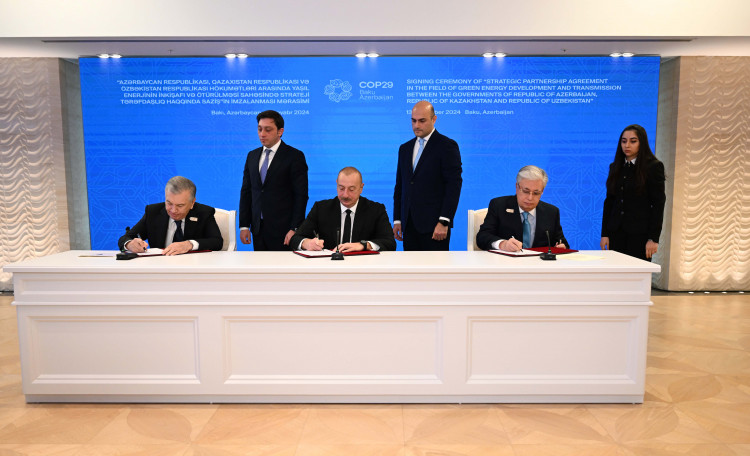
At the COP 29 World Climate Summit, leaders of Kazakhstan, Azerbaijan, and Uzbekistan signed a Strategic Partnership Agreement to advance green energy production and transmission, aiming to establish a reliable “Green Energy Corridor” for Central Asia and South Caucasus. This agreement, marked by the commitment of Presidents Kassym-Jomart Tokayev, Ilham Aliyev, and Shavkat Mirziyoyev, aims to increase the generation of renewable energy and create an infrastructure linking Central Asia with Europe.
Kazakhstan, with its ambitious carbon-neutrality goals, stands as a major transit hub in this partnership, contributing to the development of the Middle Corridor as a “green bridge” that links regional economies and bolsters energy security. The country currently hosts 148 renewable facilities, producing 6.675 billion kWh of clean energy in 2023. By 2030, it plans to add 7 GW of renewable capacity, boosting green energy’s share to 15%.
The project is expected to create new green corridors for sustainable energy exports to European markets. It will use advanced HVDC technology to connect energy systems across continents, an initiative supported by international organizations, including potential financing from the Asian Development Bank. Mehman Aliyev, an energy expert from Azerbaijan, detailed the project phases: starting with a feasibility study, followed by the construction of high-voltage power networks, including undersea cables in the Black Sea.
Azerbaijan’s renewable energy potential alone is around 27 GW, including vast wind and solar capacities. Plans are underway to reach 30% renewables in its energy mix by 2028, aiming to help meet the European Union’s demand for reliable and clean energy. Similarly, Uzbekistan is set to increase renewables to 40% of its energy mix by 2030, exporting surplus energy through this new corridor.
Experts from Kazakhstan’s Ministry of Energy noted that the ratification and subsequent implementation of the Agreement will streamline infrastructure development, creating a strong green energy export network linking Central Asia and Europe. The cooperation framework aligns with the Paris Agreement, fostering a transition toward renewable energy and reinforcing regional cooperation for sustainable energy systems.
In summary, this Agreement is a milestone in diversifying Europe’s energy sources while providing significant economic and environmental benefits to Kazakhstan, Azerbaijan, and Uzbekistan. The project underscores Central Asia’s increasing role in the global green energy supply chain.
Leave a Reply